I am a third-year Ph.D. student in Computer Science and Technology at the University of Electronic Science and Technology of China (UESTC), where I have been pursuing an integrated master's–Ph.D. program since September 2022, supervised by Prof. Shi Gu. I received my bachelor's degree from UESTC in June 2022.
Before that, I was a member of the UESTC ACM-ICPC team, where I enjoyed both the challenge of solving interesting algorithmic problems and the camaraderie of working with teammates.
My research interests include NeuroAI, computational neuroscience, and spiking neural networks.
Curious and enthusiastic, I strive to remain coachable and intellectually honest, with a growth mindset. As agentic AI lowers execution barriers, I place greater value on developing an independent perspective on where meaningful progress is possible, cultivating a taste for fundamental and consequential questions, and sharpening my research intuition through experimentation and reflection.
I am interested in research internship opportunities in reinforcement learning, continual learning, and embodied intelligence. Feel free to get in touch!
🔥 News
- 2026: Our work on task-structured modularity was published in Nature Machine Intelligence.
- 2025: Our work on temporal flexibility in spiking neural networks appeared at ICLR 2025.
- 2024: Our work on Spiking Token Mixer appeared at NeurIPS 2024.
📝 Publications
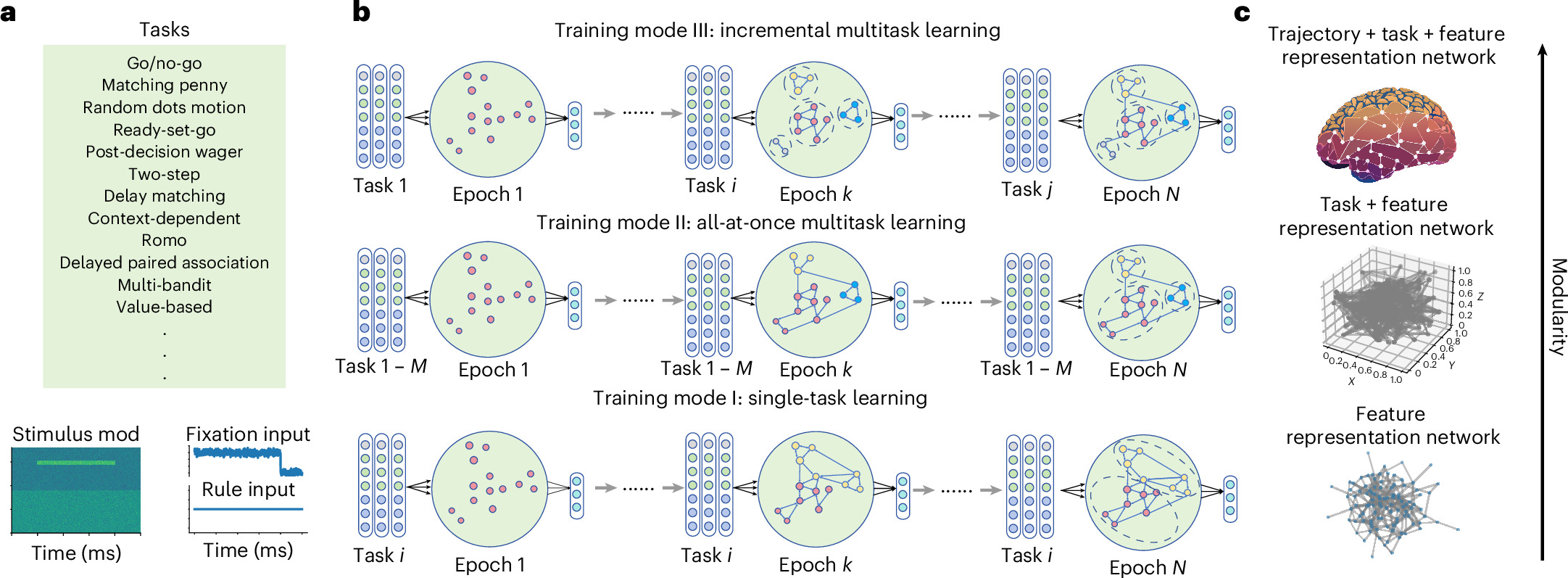
Nature Machine Intelligence · 2026
Yuhang Wu, Shikuang Deng, Kangrui Du, Marcelo G. Mattar, Yifan Wu, Dani S. Bassett, Huajin Tang, Gang Pan, Shi Gu
- Why do neural networks become modular? Comparing single-task, multitask, and incremental training in recurrent networks, we show that multitask learning promotes modularity under limited capacity.
- Growing connections during learning strengthens modularity. Combining task-derived structure with spatial constraints improves the fit to human brain networks, highlighting the role of task demands in shaping brain architecture.
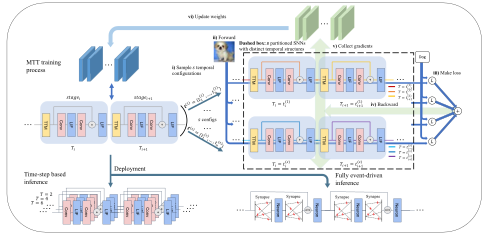
ICLR 2025
Kangrui Du*, Yuhang Wu*, Shikuang Deng, Shi Gu
- We identify temporal inflexibility in standard SNN training, which limits fully event-driven deployment and dynamic energy–performance trade-offs.
- We propose Mixed Time-step Training (MTT), randomly assigning time steps to network stages during each training iteration to improve temporal flexibility.
- We validate MTT on GPUs, neuromorphic chips, and an event-driven simulator and, to our knowledge, report the first large-model results on fully event-driven platforms (VGGSNN on CIFAR10-DVS).
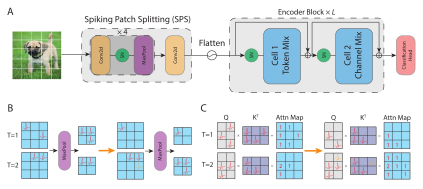
NeurIPS 2024
Shikuang Deng*, Yuhang Wu*, Kangrui Du, Shi Gu
- We propose STMixer, a spiking architecture built from operations supported by asynchronous hardware, addressing the deployment limitations of spike-based attention and pooling.
- STMixer achieves performance comparable to spiking transformers at very low time steps in synchronous settings, while supporting event-driven execution.
🎖 Honors and Awards
IEEEXtreme Programming Competition
- 2022.10 — 31st place worldwide, IEEEXtreme 16.0.
International Collegiate Programming Contest (ICPC)
- 2021.11 — Silver Medal, Asia Jinan Regional Contest.
- 2021.12 — Bronze Medal, Asia Nanjing Regional Contest.

China Collegiate Programming Contest (CCPC)
- 2021.11 — Bronze Medal, Harbin Contest.
- 2020.11 — Bronze Medal, Changchun Contest.
📖 Education
- 2022.09 – Present — Integrated M.S.–Ph.D., Computer Science and Technology, UESTC.
- 2018.09 – 2022.06 — Bachelor's degree, Computer Science and Technology, UESTC.
💻 Internships
- 2025.06 – 2025.09 — Research Intern with the Darwin team at Zhejiang University's State Key Laboratory of Brain-Machine Intelligence, contributing to brain simulation for the Wukong (Darwin Monkey) project.
- 2021.01 – 2021.07 — Autonomous Driving Perception Algorithm Intern at SenseTime, mentored by Hui Zhou.